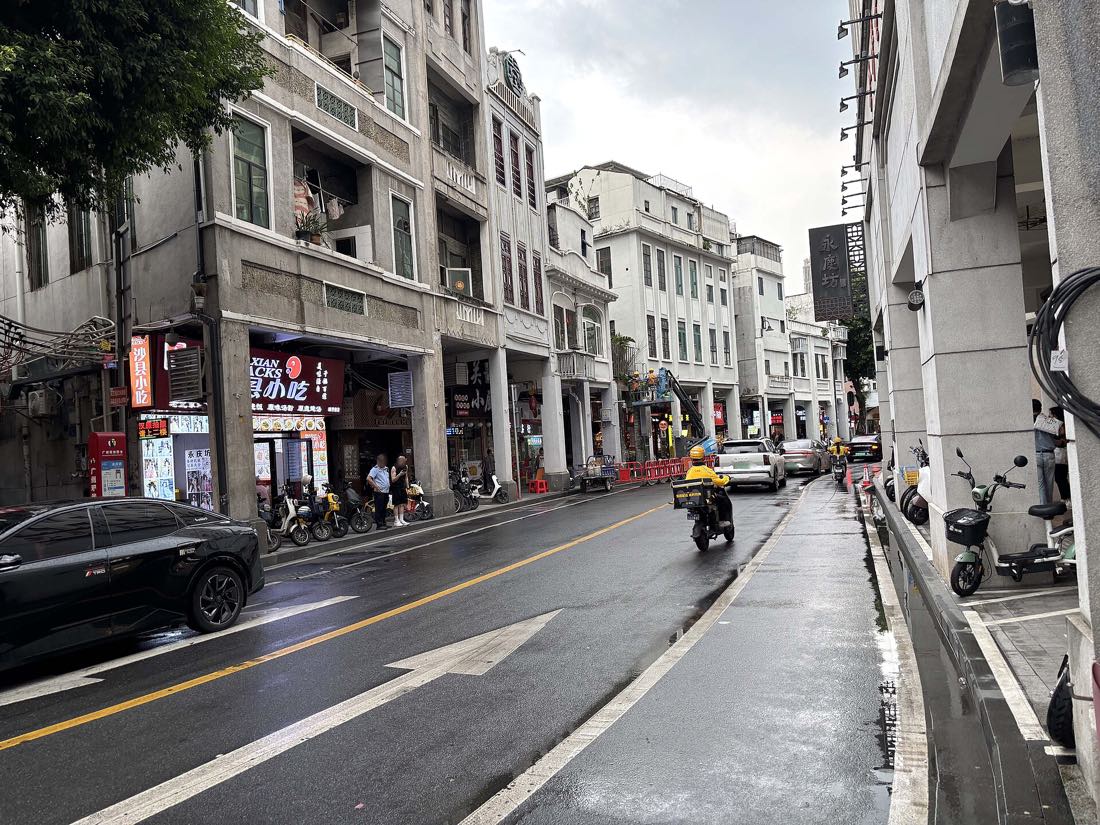
Yongqingfang and Enning Road: The Best Single Choice in Guangzhou (2026)
A ninety-year-old granite arcade street that was scheduled for demolition and instead became China's most-cited micro-renovation pilot in 2016. What survived is a working Cantonese neighbourhood with a free opera museum, a lit stone bridge, and food priced for people who live there — all of it free to walk into.
If you have one afternoon and evening in Guangzhou, spend it here. Enning Road is a 90-year-old qilou arcade street that was saved rather than cleared, and inside it you get the free Cantonese Opera Art Museum with live performances, Bruce Lee's ancestral home, a bookstore worth the detour, and a stone bridge whose reflection closes into a perfect circle once the lights come on at 19:30. It costs nothing to enter and a full day of eating well runs ¥150–250 (about $21–35). Arrive around 16:00 and stay through dark.
The street that was scheduled for demolition
Enning Road is a qilou street — granite-fronted arcade houses built to shade a pavement, the standard commercial architecture of southern China before the war. By the 2010s most of Guangzhou's had gone, and this one was next.
What happened instead, from 2016, was a municipal pilot in what the planning literature calls micro-renovation: repair rather than clearance, keeping residents in place, letting new uses fill the empty units. It worked well enough that Yongqingfang is now the case study every Chinese planning department cites. That matters to a visitor for one practical reason — people still live here. You are walking through a neighbourhood with laundry above the shopfronts, not a reconstructed set.
The comparison that decides your afternoon is with Shangxiajiu and Beijing Road, the two pedestrian streets every guide sends you to. Both are now chain retail and interchangeable snack stalls. Yongqingfang has the same architecture with a fraction of the commercial flattening, and it is a fifteen-minute walk from Shangxiajiu — if you only do one, do this one.
The essential instruction is this: go into the side alleys. The main drag through Yongqingfang is the polished part, the bit with the coffee brands and the merchandise. One turning off it and you are in lanes of low grey-brick houses, ancestral shrines, cage-window ironwork and old men playing cards. That contrast, held within fifty metres, is the actual experience.
What is actually here, and what it costs
Yongqingfang is a district rather than an attraction, and four separate things inside it are worth planning around. All of them are within a ten-minute walk of each other.
| What | Price | Detail | Verdict |
|---|---|---|---|
| Cantonese Opera Art Museum 粤剧艺术博物馆 | Free | A purpose-built Lingnan garden compound with a real courtyard stage. Free entry with a WeChat booking, closed Mondays, and there are live performances — check the schedule board on arrival. | WORTH IT |
| Bruce Lee's Ancestral Home 李小龙祖居 | Free or about ¥20 — sources conflict | The Li family house, restored. Published prices disagree: some sources list it as free, others at roughly ¥20. Carry small change and do not be surprised either way. | DEPENDS |
| Moon Bridge 拱桥 | Free | Lit from 19:30, when the arch and its reflection close into a full circle. This is the photograph everyone comes for and it does not work before the lights. | WORTH IT |
| Zhongshuge bookstore 钟书阁 | Free | One of the mirrored, theatrical Zhongshuge interiors. Ten minutes, no purchase needed, and a good indoor pause in the heat. | WORTH IT |
The Opera Museum closing on Monday matters more here than elsewhere, because it is the one ticketed-feeling thing in a free neighbourhood. Everything else on this list runs seven days.
Eating your way through Enning Road
This is the reason to arrive at 16:00 rather than at noon. Grazing here is the point, and the prices are real ones rather than the vague ranges most guides publish.
Crispy fish skin 炸鱼皮 runs ¥25–40 (about $3.50–5.50) a portion and is the single most characteristic snack on the street — thin, salted, and nothing like the deep-fried heaviness the name suggests. White-cut chicken 白切鸡 is about ¥70 for a half bird, poached and served cold with ginger-scallion oil, and it is the dish that most cleanly demonstrates why Cantonese cooking is a technique cuisine rather than a sauce one.
Double-skin milk 双皮奶 is ¥18 and worth ordering hot rather than cold at least once. A proper sit-down dim sum meal in the neighbourhood runs about ¥100 per person, which is roughly a quarter of what the same four items cost across the water at the White Swan — see the White Swan comparison if you want that argument in full.
A full day of eating well here, grazing plus one proper sit-down meal, comes to ¥150–250 per person (about $21–35). Nothing on that list requires you to order in Chinese; most of the counters have pictures, and the sit-down places take a pointed finger. The real barrier in Guangzhou is not money or language, it is the tick-sheet ordering system at the old tea houses — morning tea, decoded covers that separately.
One honest caution: the food directly on the main renovated strip is the most expensive and least interesting in the district. Walk two minutes into the surrounding streets and both of those reverse. Where locals actually eat has the named addresses.
Yongqingfang, hour by hour
This is an evening place that most itineraries schedule for the morning. Arriving at 16:00 and leaving after 21:00 is the whole trick.
★ Arrive now. Everything is open, the light is starting to work on the arcades, and you have five good hours ahead of you.
Is Yongqingfang for you?
Yongqingfang, practically
Workshops and walks in the neighbourhood
There is no ticket to buy for Yongqingfang. What is bookable here are the things happening inside it — the herbal workshops in the restored shophouses, and the walking tours that connect Enning Road to the wider Xiguan quarter.
Yongqingfang questions
Is Yongqingfang free?
Yes. The district is a public neighbourhood with no gate, the Cantonese Opera Art Museum inside it is free with a WeChat booking, and the Moon Bridge and Zhongshuge bookstore cost nothing. The only money you need is for food, and a full day of eating well runs ¥150–250 per person.
What time should I go to Yongqingfang?
Arrive around 16:00 and stay past 20:00. The shops are all open by then, the light works on the arcades from about 17:00, and the Moon Bridge lights come on at 19:30 — before which the reflection photograph everyone comes for does not exist.
How do you get to Yongqingfang?
Metro Line 1 or Line 6 to Huangsha, Exit B, then a walk of a few minutes up Enning Road. The same exit serves Shamian Island and the Xidi cruise wharf, which means one station gives you an afternoon, an evening and a boat.
Is Yongqingfang better than Shangxiajiu?
Yes, clearly, and they are fifteen minutes apart. Shangxiajiu is China's first pedestrian shopping street and is now largely chain retail with generic snack stalls. Yongqingfang kept its residents and its buildings, so the same qilou architecture comes with a working neighbourhood attached.
Can you visit Bruce Lee's ancestral home?
Yes, it is on Enning Road inside the district. Published prices genuinely conflict — some sources list it as free, others at around ¥20 — so carry small change and treat either outcome as normal. It is a restored family house rather than a large museum, so twenty minutes is enough.
What should I eat in Yongqingfang?
Crispy fish skin at ¥25–40, white-cut chicken at about ¥70 for a half bird, and double-skin milk at ¥18 are the three that define the street. A sit-down dim sum meal runs about ¥100 a head. Step off the main renovated strip first — prices drop and quality rises within two minutes' walk.
Is the Cantonese Opera Art Museum worth it?
Yes, and it is free. It is a purpose-built Lingnan garden compound with a genuine courtyard stage, and live performances are scheduled rather than constant — check the board when you arrive. It closes on Mondays, like most of the city's indoor culture.